Saturday, August 21, 2010

It’s All About Stealth


I walked toward the pond at Fenner Nature Center. Plink. Plink. Plunk. My footsteps had scared several frogs and maybe a turtle into the water. I turned on my camera. Plip. Plop. More were frightened by the electronic whir. I stalked a sleepy-looking fellow, floating with his head above the surface. I focused, wondering if reflected sunlight would spoil the picture or make it more interesting.
“Is there anything in there?” a woman shouted as she came up to the pond.
The frog disappeared into the murk. I turned so she could see my camera.
“What are you taking pictures of?” She yelled even though she was standing next to me.
“Frogs,” I whispered, hoping she’d turn down the volume.
“Oh, I see ‘em now.” She hadn’t taken the hint.
Plunk. Plop. I put my finger to my lips.
“They’re all over the place,” she shouted.
“Could you please be quiet?” I whispered. “I don’t mean to be rude, but you’re scaring the frogs.”
“They’re all over the place! They’re all over the place!” Her voice kept getting louder.
I sighed, and eventually she left. Then I managed to photograph some of the braver individuals. Stop by tomorrow to see more frog pics.

Friday, August 20, 2010

Overheard #107

"What makes you think I don’t want to be bothered?"

Thursday, August 19, 2010

Teen-Parent Relations

On Monday, NPR did a piece on teen-parent relations that I found interesting both as a parent and as a writer. The examples mentioned in the article didn’t seem real to me as neither my kids nor my characters get hysterical about what they’re going to wear on school photo day. The part about teens not foreseeing the consequences of their actions is golden.

Wednesday, August 18, 2010

Art Imitates Life

or is it the other way around?

Recently my kids have been living out some of the dramas I’ve written about. In Chapter 6 of my WIP, Michael lost his keys, and last Monday, Jeremy lost his wallet. Fortunately both boys recovered their possessions. In Chapter 20 of one of my previous novels, Lia parked near a college campus and returned to find her car vandalized. Unfortunately, Sam had the same experience in July. The repairs on Lia’s car were fast and inexpensive, but in reality, quick, cheap auto repairs are totally fictional. In Chapter 14 of my WIP, Michael flagrantly exceeded the speed limit and didn’t get caught. Jeremy was not so lucky.

You might say this is coincidence, or I could claim I’ve nailed the teenage experience. Either way, I seem to be predicting the future. I’m tempted to change the mom’s career so she’s a highly successful novelist.

Sunday, August 15, 2010

Sunday

A friend told me this is a white-faced meadowhawk.

Friday, August 13, 2010

Overheard #106

"There is never a reason for tediousness."

Thursday, August 12, 2010

Curmudgeonly Rant on Spelling

Why is it okay to spell some words in more than one way? Just decide already. Don’t tell me that ocher is just as good as ochre. How can gallivant, galivant and galavant all be correct? One spelling should be enough for any word.

In a fit of pique, I looked up ocher and gallivant.

Merriam-Webster prefers ocher to ochre. The Free Dictionary also likes the ER spelling and suggests ochery and ocherous are real words. Cute Writing tells me ochre is the British spelling. Microsoft Word shows no preference.

Merriam-Webster likes gallivant better than galavant and doesn’t even mention galivant. The Free Dictionary prefers two Ls and an I, but lists galivant before galavant. Microsoft Word only accepts gallivant.

Tuesday, August 10, 2010

Writing Retreat

When you think of a writing retreat, perhaps you envision peace and quiet, a respite from the responsibilities of family and work. Maybe you see long stretches of uninterrupted creative time, solving thorny plot problems and finding new insights into characters. You might imagine time with good friends, belly laughs and shared ideas. Or does the idea of a writing retreat summon fears of having nothing to say?

The retreat I just left was wonderful. I worked hard on revisions and made good progress. There is something about sitting across the table from another hard-working writer that keeps me on task. I solved some problems with my WIP and discovered other issues that need to be fixed. I enjoyed the time with great friends. Thankfully, writer’s block left me alone.

This was my fifth writing retreat and the third with my awesome critique group. It occurred to me I have never done new writing at a retreat. I always spend the time revising. Okay, my process involves lots of revision, but still …

Maybe next year.

Sunday, August 8, 2010

Sunday


I chased this hummingbird clearwing moth all over the yard.

Friday, August 6, 2010

Overheard #105

"It’s hard to escape the criticism of a red-winged blackbird."

Tuesday, August 3, 2010

Update


Photo by Jean Eddy
This week, I’ve been volunteering at band camp. This is a six-day stretch of early morning to late night days at which the high school marching band learns next the new halftime show. The maturity difference between the incoming freshmen and the soon-to-be seniors is astounding. Five minutes with the incoming freshmen totally validates the concept of the Tween novel.

I was appointed photographer of Jeremy’s metal band. I need a better camera.

On Thursday, The World’s Greatest Critique Group goes on our annual retreat. I hope to finish the revisions of my current work-in-progress.

Sunday, August 1, 2010

Sunday

This picture is a little confusing, but it's so hard to photograph butterflies and moths.

Saturday, July 31, 2010

Reading the Fine Print

Next week is Band Camp. The kids practice from early morning until late at night for six days, and miraculously the halftime show falls together. I signed up to help all day on Tuesday. Somehow, my name also appeared on the volunteer lists for helping all day on Monday, baking brownies, picking up eleven dozen bagels and helping with activities*.

How could this happen?

I knew when I was supposed to work, so I didn’t look at the volunteer assignment sheets until it was too late to bail out.

Sigh.

Monday and Tuesday are pretty much toast, but I’m likely to gather enough data for a couple more novels.

*Man, I hope I get water balloons instead of word games this year.

Friday, July 30, 2010

Overheard #104

"Dialog attribution clutters up your white space."

Thursday, July 29, 2010

High School English

Jeremy: How’s the novel going?
Me: I got back comments from Amy. She’s an English teacher.
Jeremy: Were they constructive?
Me: Yes.
Jeremy: Did she tell you to use more metaphors, similes and personifications?
Me: No.
Jeremy: They’re the only things that are important – other than overlying themes.

Wednesday, July 28, 2010

Wednesday

Bunnies don't like to be photographed.

Sunday, July 25, 2010

Sunday

rose and unidentified insect

Saturday, July 24, 2010

Take a Liking to a Viking

I admit I like Vikings. Their behavior was often unacceptable by today’s standards, but still, they have a certain romantic appeal. Plus, Vikings are the local high school’s mascot, and my maternal grandparents were Danish.

I’ve been reading the Saxon Tales by Bernard Cornwell and picked up some Viking trivia.

Horned helmets: I already knew the horns were a myth. No warrior involved in hand-to-hand combat would wear a hat with handles that could be grabbed by the enemy.

Longboats: The fanciful beasts carved on the prows could be removed when the ship was used for trading. Many of these trade missions were reconnaissance designed to identify the richest villages to plunder later.

Vikings: Back in the day, these folks were known as Danes or Norsemen. The word viking was a verb. To go viking was to go plundering, pillaging and burning.

Friday, July 23, 2010

Overheard #103

"We used to skinny-dip. Now we chubby-dunk."

(This quote was overheard by one of my facebook friends, but I couldn't pass it up.)

Thursday, July 22, 2010

Did I Mention Loud?

Metal Band Update

Me: That’s the best I’ve ever heard you play.
Jeremy nods.
Me: But if it’s that loud two floors up, you need to wear ear plugs.
Jeremy: We’ll turn down the volume.

The lesser of two evils.

Sunday, July 18, 2010

Friday, July 16, 2010

Overheard #102

"Power ballads are songs girls like, and guys pretend to like so girls will like them."

Wednesday, July 14, 2010

Words of Wisdom

Thanks to Ruth McNally Barshaw for this bit of genius.

"Sometimes writing is hard.
Sometimes it flows and it's perfect and you even know that, as it comes out of your pen.
And other times it's like each word is a splinter and your pen is the tweezers..."

Look for Ruth’s third book Ellie McDoodle Best Friends Fur-Ever early in August.

Tuesday, July 13, 2010

Metal Inspiration

Me: What song are they playing?
Sam: It’s the one Jeremy wrote last night.
Me: He wrote a song – while they were moving the drum set?
Sam: They were talking about how irritating it is when Katie calls them Hon so I suggested they write a song called Attila the Hun. I think that’s it.

Monday, July 12, 2010

Brilliant!

If you’ve ever tried to wade through Joseph Campbell’s Hero with a Thousand Faces or studied the Hero’s Journey in other forms, click here. Justus R. Stone sums up the whole thing brilliantly.

Sunday, July 11, 2010

Saturday, July 10, 2010

Heavy Metal Mama

Jeremy and two friends formed a metal band. Neil plays drums, Katie sings, and Jeremy plays guitar and writes their songs. Yes, I’m proud. I’m also worried about potential hearing loss - for the band members.

They used to practice at Neil’s house because he has a super-fancy drum set and a finished basement. Neil also has four cats, and unfortunately Katie is allergic.

Sigh.

So, much of the summer has been devoted to converting our unfinished, extremely cluttered basement into a practice space. They cleaned out one corner and hung old blankets to form a room. I contributed dorm room carpet from Home Depot, and we’re still discussing economical sound proofing options for the remaining two walls. They installed a mini-fridge for soft drinks and even plugged in my old metronome.

Still, our new sound stage isn’t perfect.

Jeremy: We have ants down here.
Me: Are they the big ones or the little ones?
Jeremy: I don’t know. Medium.
Me: It makes a difference. The little ants love ant traps. They rush right in and eat the poison. The big ones are carpenter ants, and they don’t like traps so much.
Jeremy: There’s a dead one in the corner. Wanna see?
Neil: Wow. Maybe we could write a song about ants called Poison.

Friday, July 9, 2010

Overheard #101

"Tattoos are freckle envy."

Wednesday, July 7, 2010

The Writing Space

Usually, I plunk myself down in front of my huge computer desk in the bedroom and type away. This space is not glamorous or particularly neat. It doesn’t even have a convenient window, although one might argue the monitor is a window to my imagination.

Sometimes people from my writing group meet at a local bookstore café to write. There is something about seeing other people working hard that makes me work hard. (Of course they are probably working hard because they think I’m working hard.)

Near the spot where yesterday’s squirrel was resting, we have a couple chairs and tables. It’s shady all day, birds sing, and breezes rustle leaves. I never write there. The laptop cord doesn’t reach, it’s hard to read the monitor in natural light, and there’s no place to put the mouse. I realize these problems have simple solutions. Still, that spot is better for reading than writing.

Where do you write?

Tuesday, July 6, 2010

Even the Squirrels Are Hot

I took this through the window and there’s some glare off the glass.

Sunday, July 4, 2010

Sunday

I’m pushing the resolution of the camera on this one. These little flies are fast; I was lucky to capture one.

Friday, July 2, 2010

Overheard #100

"That takes infinity of time, and we just don't have it."

Tuesday, June 29, 2010

It’s Not Over ‘Till Somebody Spills

Or is it?

All good things must end – including novels. At some point, every writer has wrap up the story and clarify mysteries. Some authors use a character to explain everything. Hercule Poirot gathers all living suspects in the drawing room and describes his deductive reasoning. Harry Potter and Lord Voldemort duke it out with wands and words several times, and Lord Voldemort gets to do most of the talking.

Those final soliloquies are so tempting to write. I had one in my WIP, until I realized it wasn’t necessary. The story still made sense when that dialog was cut. Changes could be made earlier in the novel to release clues. Now the ending focuses on the protagonist’s victory, not the antagonist’s defeat.

Sunday, June 27, 2010

Friday, June 25, 2010

Overheard #99

"That makes something not completely unlike sense."

Thursday, June 24, 2010

Happy Midsummer

Tonight is Midsummer Night, and my dream of serene sunny days filled with productive writing has not yet materialized. Revisions are limping along, this blog is neglected. Other people are blogging though, and I’ll send you off to visit them.

On Wednesdays, Alice Pope’s SCBWI Children’s Market Blog, compiles helpful industry posts, and two caught my eye. Mary Kole at kidlit posted a letter from a reader about using a good telling sentence to introduce showing. This is similar to starting a paragraph in an essay with a topic sentence then backing it up with specific examples. Jennifer Crusie wrote a terrific, content-filled post on plot in Argh Ink.

Tuesday, June 22, 2010

Pink Flamingo

Today, I'm over at Happy Mailboxes, a very cool blog by the fabulous writer, Lisa Wheeler.

Sunday, June 20, 2010

Friday, June 18, 2010

Overheard #98

"He was off in the Sam-osphere."

Thursday, June 17, 2010

More on Plot Problems

So what is a plot problem? When I introduced my exercise at Tuesday’s Write Night, I was asked to give an example. A plot problem is anything that isn’t working, doesn’t make sense, or bogs down the story. Plot problems are easy to revise around and delightful to put off, but eventually they have to be faced.

Here are examples from the group that don’t give away anyone’s story.
  • Getting a character to do something he didn’t want to do
  • Explaining an essential technicality of a magical world with humor
  • Rescuing characters from a high-tension, hopeless situation
  • Bringing two disparate characters together
  • Adding excitement to a lack-luster sequence of events
 In case you haven’t guessed, the last one was mine. Yesterday I replaced a chapter of sludge with action and tension.

Wednesday, June 16, 2010

Plot Problems

Last night's Write Night exercise seems to have worked out well - if I do say so myself. Here's the exercise.

Briefly summarize a plot problem in your novel.

Make a list of 5 or 6 solutions. (They don’t all have to be practical. They don’t all have to work. Brainstorm wildly.)

Pick one solution and write a scene that begins to implement it.

Sunday, June 13, 2010

Friday, June 11, 2010

Overheard #97

"In my next life, I’ll have poise."

Thursday, June 10, 2010

LIAR: the Unreliable Narator

Liar
by Justine Larbalestier

Bloomsbury, 2009

Picture shows the new US and Australian covers.

For reviews, see The YA YA YAs, Librarilly Blond, Bib Laura Graphy, A Chair, A Fireplace and a Tea Cosy, and The LibrariYAn.

This book is not for the squeamish. It has a raw brutality that even the multiplicity of lies can’t mask. That aside, Liar is a masterful example of the unreliable narrator. The tale drips out slowly as if Micah is reluctant to tell us the truth. Then the story shifts and Micah admits she’s lied, and promises to be honest next time. Then the story shifts again. And again.

If you’re writing a novel with an unreliable narrator, there’s much to learn from this book.

Tuesday, June 8, 2010

Bargain Vacation – Transylvania


Wildwood Dancing

by Juliet Marillier

Alfred A. Knopf, 2007


For reviews, see teen reads, Emily’s reading room and the book book blog.
 
 
Fascination with vampires has made Transylvania an increasingly popular vacation destination. In Wildwood Dancing, the reader can observe Night People from a safe distance and still enjoy moonlight revels with inhabitants of the Other Kingdom. Dancing lessons and haute couture ball gowns are included in the price.
 
“Children love forbidden places, especially when they lie deep in a mysterious dark forest, where all kinds of wonderful games can be played, games that last from dawn to dusk and spring to life again the next morning.”

Monday, June 7, 2010

NYC Libraries

Jump on over to Jumping the Candlestick to get all the details.

Sunday, June 6, 2010

Sunday

Here's a damselfly link.

Friday, June 4, 2010

Overheard #96

"If you turn into an alien, can I have a ride in your
 UFO?"

Wednesday, June 2, 2010

Tuesday, June 1, 2010

Bargain Vacation - France

The Vintage Caper

by Peter Mayle

Alfred A. Knopf, 2009

For reviews see New York Times Sunday Book Review, goodreads, and Wine Peeps.

If you needed an excuse to frolic through France, sampling culinary delights and indulging in fine wines, you could join Sam Levitt as he investigates the theft of three million dollars worth of aged Bordeaux.
 
“Returning to Paris after a long absence, there is always a temptation to plunge in and taste everything. Call it greed, or the result of deprivation, but food in Paris is so varied, so seductive, and so artfully presented that it seems a shame not to have a dozen of Brittany’s best oysters, some herb-flavored lamb from Sisteron, and two or three cheeses before attacking the desserts.”
 
“The restaurants of Marseille were the reason God made fish.”

On Cassis: “A village on the sea is a magical sight on a sunny day; a village on the sea with twelve excellent vineyards in its back garden is enough to make a man want to throw away his passport and stay forever.”

Sunday, May 30, 2010

Saturday, May 29, 2010

The Sameness of It All

Yesterday while working in the garden, I realized that revising a novel is a lot like yanking out the weedy stuff and nurturing the colorful stuff.

Friday, May 28, 2010

Overheard #95

"Subtlety is potentially ineffective."

Thursday, May 27, 2010

Purposeful Revisions

I once heard an editor say that every revision should have a purpose. While this may not work for every writer, focusing on a specific problem can tame the seemingly overwhelming task of revising rough drafts.

The purpose of the first draft is Getting the Story Down.

For my WIP, the second draft is the Logic Draft. Before I started writing, I outlined the novel in detail, but I deviated from the plan and introduced a few subplots near the end. These changes had to be set up early in the story for them to make sense.

The third draft is the Page Turner Draft in which I slash and burn the boring stuff. I make sure my subplots overlap so that when one resolves, there are still plenty of things to worry about.

The fourth draft will be the Voice Draft. This is simply a page by page analysis to make sure all characters stay in character.

After that, I’ll read it and decide.

Wednesday, May 26, 2010

Wednesday


Okay, the duck is a bit dark and the background is too light, and Photoshop could fix all that, but there's this novel to revise ...

Tuesday, May 25, 2010

Bargain Vacation - Botswana

The No. 1 Ladies’ Detective Agency

by Alexander McCall Smith

Random House, 2002

For reviews see About.com and BookBrowse.
Here is a YouTube video of the TV series.

This book is less like taking a vacation than moving to Botswana and setting up shop amid the dust, sweltering heat and fierce beauty of the land. You’ll drink innumerable cups of bush tea and become accustomed to a slower pace of life. You’ll learn not to get on the wrong side of witch doctors and when searching for missing persons, you’ll remember to check if leopards or crocodiles are in the area. Although the book is a quick read, this is not a short vacation. Be prepared to settle in.
 
“When you see these hills from a distance, they are blue; as all the distances in this country are. We are far from the sea here, with Angola and Namibia between us and the coast, and yet we have this great empty ocean of blue above us and around us. No sailor could be lonelier than a man standing in the middle of our land, with the miles and miles of blue about him.”

Sunday, May 23, 2010

Friday, May 21, 2010

Overheard #94

"Okay guys, ties and flies."

Tuesday, May 18, 2010

Bargain Vacation - India

Our summer vacation seems to be a non-starter this year, so, I thought I’d share snapshots of my recent literary travels. These trips are free from the library, no vaccinations or passports are required, and some include time travel bonuses.

Tiger Moon

by Antonia Michaelis
translated by Anthea Bell
Amulet Books, 2008

For reviews, see teen reads, Powell’s books, writing with a broken tusk and charlotte’s library.


If you’ve ever wanted to experience a monsoon, visit a desert oasis, see the River Ganges or rescue a princess, read Tiger Moon. One review (writing with a broken tusk) quibbles with cultural, geographical and historical aspects of the novel, and I admit I’m not qualified to judge these topics. That aside, this mini-vacation includes the opportunity to ride a white tiger, an experience unavailable on many costlier tours.

"How does a story of India begin?
Does it begin with the three rivers the Ganges, the Yamuna, the unseen Sarasvati pouring her dreaming waters down from the snowy mountains to the hot, dry plain?"

Tune in next week for more travel discounts.

Sunday, May 16, 2010

Friday, May 14, 2010

Overheard #93

"Big Brother is texting you."

Wednesday, May 12, 2010

Slush

Writer’s Digest has a checklist for improving rough drafts. 21 Tips to Get out of the Slush Pile by James Plath.

Check it out. It covers more than simply eliminating typos.

Tuesday, May 11, 2010

Gender Guesser

One of my facebook friends mentioned a website that analyzes word choice to predict if a text sample was written by a man or a woman. Since my WIP has a male protagonist, I was eager to try. I pasted the first 300 words into the box and got weak female. Okay, that was disappointing, but the project still needs work, so I checked the first 300 words of TAoCBS (male protagonist) and got weak male. Better. Third time’s the charm. I pasted in 300 words of CBL (female protagonist) and again got weak female. Phooey.

As a former scientist I felt compelled to test the system. I tried a couple posts from this blog and got male. Uh oh. Then I pasted in several posts from other people’s blogs, and they all came out male – no matter who wrote them.

Fiction is different than blogging, so I have a favor to ask. Will you test 300 or so words of your fiction here and post the results in comments? Just say whether your protagonist is male or female and if the gender guesser agreed. Thanks.

(I’m secretly hoping the results will be meaningless.)

Monday, May 10, 2010

Blue Plate Special


Blue Plate Special

by Michelle D. Kwasney

Chronicle Books (2009)


This YA novel traces the stories three generations of women/girls in a dysfunctional family. For reviews, see Frenetic Reader and goodreads.

Blue Plate Special is a fascinating study of voice. The story is told in three first person points of view and the three voices remain distinct throughout the novel. None of the voices is particularly eccentric, yet they do not merge or mimic one another. Michele Kwasney excels at keeping each character’s personality true.

Writers are often told it is difficult to sustain an unconventional (quirky, sarcastic, humorous, regional, ultra-intellectual) voice all the way through a novel. Maintaining three separate but equal voices must also present interesting challenges. I recommend this book to writers who are striving to perfect their character’s voices.

Sunday, May 9, 2010

Friday, May 7, 2010

Overheard #92

"Sometimes getting out of work is more work than just doing the work."

Thursday, May 6, 2010

The Fixer Upper

Starting round two of novel revisions is like buying a fixer upper. The first step is deciding if the project has potential. Is that lovely view worth the time and effort required to make the house beautiful? Is the concept behind the novel strong enough to raise a meandering tome out of the slush?

The second step is deciding where to start. Probably everyone can agree that the avocado shag carpet or the last scene in chapter 18 have to go, but they may not be the most pressing problems.

Next a plan is required. Before I start reconstruction, I need to know which walls are load-bearing and if pipes and wires are hidden inside them. If I eliminate that subplot, does my antagonist’s character arc fall flat? Are there other places to put those wires, pipes and character developing scenes?

For the time being, I’ll focus on removing enough clutter so the structure is visible. When it’s time to go in with the sledge hammer, I’ll know what to do. The project seems daunting. As the proud new owners of a bargain property once told me, “Every surface of every room needs repair.”

Tuesday, May 4, 2010

Rainbow


We don't see many rainbows in Michigan because the sky is often overcast after rainstorms. This photo is cropped strangely, because I was trying to delete the neighbor's roof.

Monday, May 3, 2010

SCBWI-Michigan Spring Conference

On Saturday I attended the SCBWI-MI 2010 Spring Conference, The Tortoise and the Hare: Journey to the Finish Line. There was a star-studded line-up, and the conference was packed with useful information about writing and illustrating.

I was reminded of ideas that had been put aside while I struggled with writing or revising, and the speakers organized information in a way that made it fresh. Here are the pearls of wisdom I gathered.

Jay Asher explained how to build suspense by creating overlapping subplots, so that when one problem is resolved, other issues remain to keep the reader turning pages.

Beth Fleisher advocated mapping arcs for plot, character, emotional development and setting.

Ruta Rimas discussed analyzing a manuscript word by word, at the level of sentences and by paragraph.

Donna Gephart suggested we fill in the blanks in this sentence for our protagonists: I’ll do anything to ___, just don’t ask me to ___.

It was an action-packed day, and unfortunately I didn’t get to hear all of the speakers.

Sunday, May 2, 2010

Friday, April 30, 2010

Overheard #91

"The pan is mightier than the swordfish.”

(sad but true)

Monday, April 26, 2010

Self-Centered Saturday

I ignored the urgent email requests to help chaperone Jeremy’s high school band’s trip to the State Music Festival. (They got along fine without me.) I didn’t attend Sam’s promotional belt test at the Tae Kwon Do studio. (It was an intermediate-level test, not one of the biggies.) Instead I went to a book signing by Laura Resau.

Laura has been one of my favorite authors for some time now because I admire:
  • the rich, accuracy of the settings
  • the complexity of the characters
  • the beauty of the language
  • the opportunity to find out about other cultures
  • her knack for total-immersion storytelling
A few other writers, including Ruth McNally-Barshaw, attended the signing, and we had a terrific afternoon discussing the writing process and its many challenges. Not only that, I got signed copies of The Indigo Notebook and Star in The Forest.

Indulge yourself. Pick up some of Laura’s books, sit back and enjoy.

Sunday, April 25, 2010

Saturday, April 24, 2010

Ask a Ninja

On Thursday, I finished the first draft of my new novel, SSA. Man, is it rough! Fortunately, Sam will soon be in a homework-free zone and available to advise me on the scenes involving Tae Kwon Do. He’ll probably even demonstrate moves. It’ll be like having my very own Ask a Ninja.

Friday, April 23, 2010

Overheard #90

(back by popular demand)

"All they can say is no."

Wednesday, April 21, 2010

Accents, Dialects and Languages

Yesterday evening at Write Night, we worked on the following exercise. I found it very difficult, even though I thought it up.

1. Write an innocuous statement.
2. Rewrite it using a different accent, dialect or language.
3. How would your protagonist react to the statement in #2?
  • a. Is it familiar, foreign, interesting, scary, impressive, despicable, etc.?
  • b. Is the character aware of his/her reaction?
  • c.  Does the character show or hide his/her reaction?
4. Write a scene depicting your protagonist’s reactions to the accent/dialect/ language.

5. Write a second scene in which you change the character’s reaction to the accent/dialect/language, with the emphasis on 3b. (If your protagonist was conscious of the reaction in the last scene, make him/her unaware this time or vice versa.) The scene may be a continuation of the last one or something completely different.

Tuesday, April 20, 2010

Excel

It feels like I’ve been working on my current rough draft f o r e v e r, but in reality, I started in on February 8th of this year. I know this because back in November, I started keeping an Excel file to track my writing progress. Aside from columns for the date, project name, word count and notes, I have column for distractions and excuses. It’s wonderful to have a private place to whine, and because it’s an Excel grid, I have to be brief. Last Sunday, next to a measly word count, I typed the word flood. I won’t expound on that here, except to say future entries in this column will include dry wall repair and painting.

Sunday, April 18, 2010

Wednesday, April 14, 2010

Tuesday, April 13, 2010

Words

Sometimes a good writing day is when my fingers fly over the keyboard. A thousand words sparkle on the screen, my plan unfolds, and the direction for tomorrow is clear.

Sometimes a good writing day is when I stare at the screen and it remains blank. Finally dredge up a page, each word worse than the one before.
I delete it, grind out a page and a half, and keep one sentence – not for its words but for its idea.
After a while, if it’s a good writing day, I type a paragraph that shows me the direction for tomorrow.

Monday, April 12, 2010

Writing and Photography

A good photograph is like a good scene. Both tell a story. Both the writer and the photographer must decide where to focus, on the appropriate depth of field, when to zoom in, when to include the big picture. Both consider motion and stillness, light and dark. The other day I noticed photos on the school website that happen to feature my sons. The concepts that make these photos compelling also apply to revising.

Shun the mundane. Sousaphones are weird instruments with their curving shapes and unwieldy size. The photographer focused on the unusual, so Jeremy and his Sousaphone are in the picture. When revising, I look for the point of interest in the scene and decide if it is interesting to the intended audience.

Focus on Tension. The photographer aimed down the line of scrimmage a moment before the football was hiked, two moments before impact. The D-line is tensed, muscles bulging, waiting to slam into their opponents. Tension crackles from this photograph, and Sam, the (former) nose-tackle, is in the picture. When revising, I delete or rewrite scenes that have no tension.

Sunday, April 11, 2010

Friday, April 9, 2010

Double Standard

“Just because my characters drink milk straight out of the jug, doesn’t mean you can.”

Yeah, I did say that today.

Thursday, April 8, 2010

Body Image

In Hope Vestergaard’s article, FLIPPING PANCAKES WITH A SHOVEL: Crafting and Promoting Compelling Books for Babies and Toddlers, she encourages picture book writers to get down on the floor and view the world as toddlers do. The same idea can apply to writing for teens.

Novelists are frequently told to “get into the heads” of their characters, but what about getting into their bodies? Being in a teen body is more than worrying about sexual development and acne. My sons were unusually clumsy right after a growth spurt because they didn’t know where their hands and feet were. Oily hair, erratic hormones and killer cramps can all be part of the picture. Don’t forget the weird stuff. That cute little pug nose is suddenly Roman. Straight hair may become curly. Eagle-eyed kids need glasses. Personally, I’d like to forget the unpleasant parts of being a teen, but my characters keep reminding me.

Wednesday, April 7, 2010

In A Rut

Here's another picture of that plant. It sure is weird.

Tuesday, April 6, 2010

Salutations

When my sons were beginning Tae Kwon Do students, they had to learn Korean vocabulary, including how to say hello in a respectful manner. I started thinking about the different ways we say hello. Greetings can show characters’ relationships, how they feel about one another, their social status, and sometimes the time and place. Here’s a list of salutations with different connotations.

Hello
Hi
Hey
Hey you
Yo
Hello there
Hi there
Hey there
How do you do?
Howdy
How are you?
HRU
How are you doing?
How’s it going?
Good day
G’day
What’s up?
ZUP
Ahoy
Good evening
Good morning
Greetings
Salutations
Welcome
Do you read me?
Come in
Dear (name)
Dear Sir or Madam
To Whom It May Concern

Sunday, April 4, 2010

Sunday

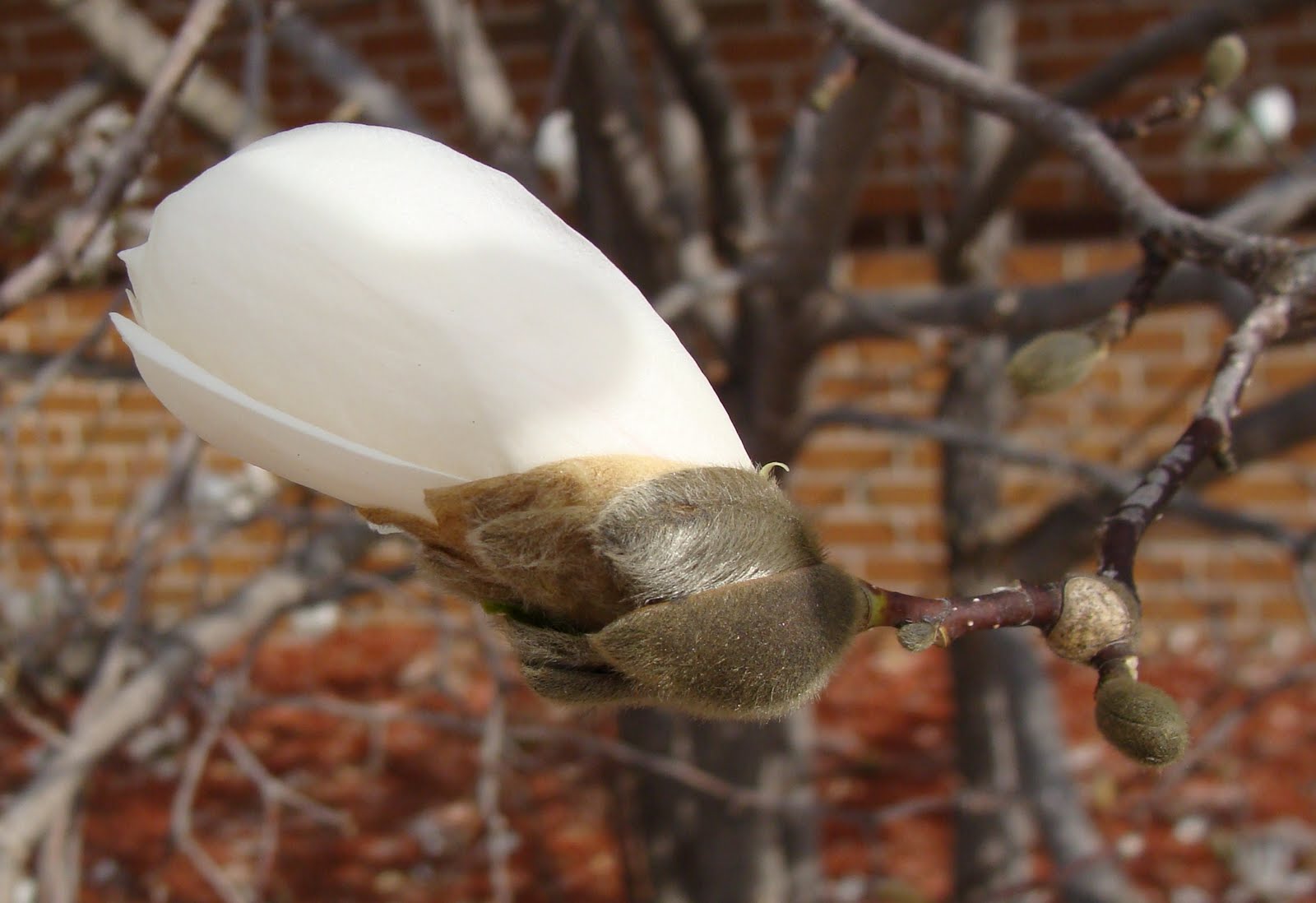
The radiant heat from the brick wall caused this magnolia to bloom early.

Friday, April 2, 2010

Spring Peepers, Door Handles and Inertia

I posted on facebook that I’d heard the first spring peepers, and a friend replied, “Well, get out there and photograph them, and post the pictures.” I shall try. Frogs are less skittish than turtles and often wait for me to focus.

At Saturday’s critique group, I plan to unveil Chapter 1 of my new novel. As I tweaked words and sentences, that old song from HMS Pinafore popped into my head. “And I polished up the handle on the big front door.” A door handle just might work as a metaphor for a first chapter.

Although it feels like I’ve been working on this first draft forever, it’s only been two months. I’ve worried that if I slow my pace, I’ll never get going again. I can still hear my father’s voice defining inertia. “A body in motion tends to remain in motion. A body at rest tends to remain at rest, unless they are acted upon by an external force.” I’m trying to remain in motion.

Thursday, April 1, 2010

This Bud's For You

I wish I'd remembered to write a funny spoof in honor of today.


I guess I'll finish the taxes instead.

Wednesday, March 31, 2010

Thinking About Graphs

Today is the birthday of Rene Descartes. People usually remember him for saying, "Je pense donc je suis." (I think therefore I am.) For me, his most important accomplishment was identifying the relationship between geometry and algebra, thus laying the foundation for analytical geometry. Cartesian coordinates are named after him, although he did not carry his mathematical research far enough to plot a line.

References:
http://www.notablebiographies.com/De-Du/Descartes-Rene.html http://mathforum.org/cgraph/history/descartes.html
http://www.freeessays.cc/db/30/mdg2.shtml
http://en.wikipedia.org/wiki/Ren%C3%A9_Descartes
http://en.wikipedia.org/wiki/Analytic_geometry

Tuesday, March 30, 2010

Contest Announcement

Moonrat is celebrating the 500,000th hit on her blog with a contest for a 20 page critique. Click here for details.

Revision Quote from Laurie Halse Anderson

"Revision means throwing out the boring crap and making what’s left sound natural."

Sunday, March 28, 2010

Saturday, March 27, 2010

Nostalgia

The other night we watched The Mystery of the Blue Train by Agatha Christie. As Hercule Poirot gathered clues and investigated suspects, my husband said, “This would be a lot simpler with DNA evidence.” It got me thinking about how contemporary novels have changed.

Remember when:
  • Mystery novels were built around clocks and train schedules instead of cheek swabs and blood tests
  • Spy stories involved confrontations with the Soviet Block
  • It was impossible to reach a character by telephone
  • Pirates marked the spot with an X not global coordinates
  • The guilty worried about destroying incriminating negatives rather than deleting files
  • Questions of paternity could support an entire plot

Wednesday, March 24, 2010

Little Shop of Horrors


This is what Sunday’s bud looks like a few days later. I particularly like the purple tentacles writhing up the green bumpy part. Won’t somebody please put it in a fantasy or sci-fi novel?

Tuesday, March 23, 2010

Write Night Exercise: Letter Writing

This Write Night exercise was inspired by Elegy for the Personal Letter by Allison Joseph. Here’s the exercise for those who could not attend.

Write two letters from one character in your novel to another character in your novel. The second letter should be written by a different character than the first. Remember voice!

The second letter may be a response to the first, but it doesn’t have to be.

The two letters should convey opposite emotions. Choose a pair of emotions from list and write one letter to depict each. (The order doesn’t matter.) If I omitted your favorite pair of emotions, feel free to write about those.

Happy/Sad
Angry/Pacifying
Accusatory/Congratulatory
Triumphant/Defeated
Industrious/Lazy
Hope/Despair
Fear/Bravery
Love/Hate
Grief/Joy
Anticipation/Surprise
Aggression/Submission
Guilt/Innocence
Pride/Shame
Envy/Selflessness
Disgust/Pleasure
Exhausted/Energetic
Regret/Satisfaction
Worry/Relief
Embarrassment/Self-esteem

One letter should tell the truth. The other should be a lie.

Sunday, March 21, 2010

Sunday

signs of spring

And I spotted two red-winged blackbirds and a field full of robins.

Friday, March 19, 2010

Catch a Sunbeam in a Cobweb


It’s been a while since I posted a weird picture. Remember this one?

Is anybody writing spooky stuff? Perhaps your hero will journey through the underworld today.

Tuesday, March 16, 2010

The Dreaded Synopsis

For the past week or so, I’ve been struggling with the synopsis for TAoCBS. My attempts fell into the common pitfall of Way Too Much Detail. This morning a new approach succeeded.

1. Figure out the shape of your novel.
Is it a linear progression in which A causes B causes C? Does it have a branching tree shape, where one event sets several things in motion? Does it resemble a capillary bed with diverging and converging plot elements? Does it look like a funnel in which several seemingly disparate events coalesce at the climax?

2. Draw your novel.
Make brief notations about plot events and connect them with arrows. I like to use jagged-lined arrows for high-conflict. Remember the shape of your novel as your draw.

3. Decide which plotlines are essential for the synopsis.
It may not be possible to include every subplot in a one-page description.

4. Write the synopsis based on your diagram.
Think brief. Think essential.

5. Edit and cut.